
Large Topic, Small Format
This is not a blog exploring Chinese pulse medicine. Really.


Sometimes I leap into a subject that intrigues me, only to find it’s too large or too complicated for my Pooh Brain. I would love to write about those topics, but the time to research and the space to publish them are finite.
Here’s an example. I’m fascinated by the pulse diagnosis of Traditional Chinese Medicine (TCM) doctors and acupuncturists. In a recent blog post, I mentioned that I was told the practitioner takes 9 pulses.
In truth, there are 28. Some books say 32. Amazing.
Most of the literature I consulted is pretty straightforward about what each pulse “feels like” and what it indicates to the physician or acupuncturist. Some of the books and articles translate that information into Western medicine nomenclature.
Readings are taken at the radial arteries in both wrists of the patient. This is the most common site for the acupuncturist or the TCM physician to place their three fingers: the index, middle, and ring fingers.
In his article “Chinese Medicine Pulse Diagnosis Explained,” Dr. Eric Tsai notes that the pulse is a dynamic, complex reflection of your body’s entire ecosystem. The qi and blood flowing through your arteries can be thought of as a river, with depth, flow rate, and obstructions that an experienced practitioner can feel.
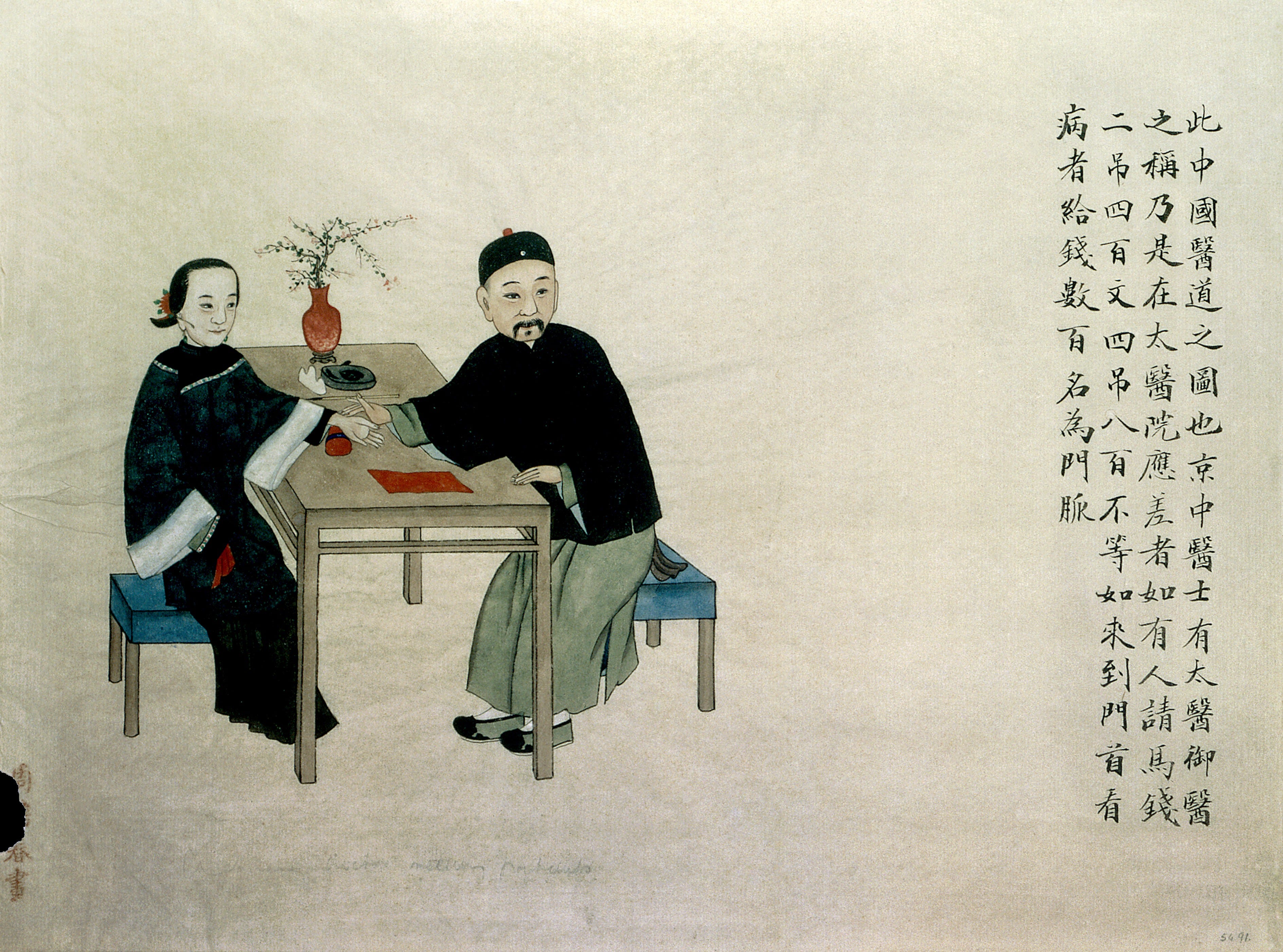
The Fu, or superficial pulse, is easily felt near the skin’s surface and often indicates external infections or acute inflammation.
Without consulting a watch or pulse monitor, the practitioner counts the beats relative to the respirations, usually 4 to 6 per inhalation and exhalation.
The deep pulse, Chen, can only be felt with firm pressure and indicates dysfunction of internal organs.
There are another 26 or 28 pulses taken, with names like Dong, or Moving pulse; Jie, or Knotted pulse; and Xian, or Wiry pulse, each giving the specialist a part of the puzzle of the patient’s health.
While researching Chinese pulse lore, I discovered a modern exploration of pulse diagnosis by a group of scientists, published in the Journal of Traditional and Complementary Medicine, but I’m unable to make any sense of it.
The article compared wrist pulses from various patients with the findings of Traditional Chinese Medicine practitioners. To reduce subjectivity, they used sensitive instruments, then subjected the findings to eigen-vector matrix analysis with sentences like ” … the tool of pulse examination constructed according to eigen-vector with specific time domain and position.” For me, and I think for most of my readers, eigen-vector analysis, which is a complex mathematical system involving a matrix of vectors, is a bridge too far.
It’s trying to objectify a practice that has been working for several thousand years and has been continually improved by generations of experienced TCM doctors. Even before the Yellow Emperor’s Inner Canon of Medicine (Huangdi Neijing), which is the foundation of Traditional Chinese Medicine, was first published around 500 BCE, pulse diagnosis had a long history.
Because I’m not a trained TCM or acupuncturist, I can’t offer you a realistic, reasonable discussion of what the pulses reveal. In addition, a deep dive would take months of research and weeks of writing to produce an enlightening, educational article short enough to read over morning coffee.
So that’s why this blog post isn’t about exploring Chinese pulse medicine. Really.
These are some of the references I consulted. There are more.
1. Tsai, Eric, MD, Chinese Medicine Pulse Diagnosis Explained
https://acupclinic.com/chinese-medicine-pulse-diagnosis/ accessed 5/1/26
2. Piroska, Hideg, Traditional Chinese Pulse Diagnosis, Substack article,

3. The Britannica, https://www.britannica.com/biography/Bian-Qiao
4. Sacred Lotus, https://www.sacredlotus.com/go/diagnosis-chinese-medicine/get/4-pillars-pulse-images-tcm-diagnosis#google_vignette
Accessed 4/30/26
5. Giovanni Maciocia and Sebastian Maciocia, The Practice of Chinese Medicine: The Treatment of Diseases with Acupuncture and Chinese Herbs, 3rd Edition, Publisher Churchill Livingstone, Publication date, July 9, 2021- accessed 5/1/26
6. Wang, Y. Y. L., Wang, S. H., Jan, M. Y., & Wang, W. K. Past, Present, and Future of the Pulse Examination (脈診 mài zhěn). Journal of Traditional and Complementary Medicine, 2(3), 164. https://doi.org/10.1016/s2225-4110(16)30096-7
I'm reading a book about Aryuvedic medicine which is also thousands of years old. They use the same pulse points and TCM. I guess they were all on to something!
Really? I would venture that eigen-vector analysis is a bridge too far for me as well. I will say that you've presented me with more information about the pulse than I would've discovered on my own reading the things that I read. Thank you and happy Friday!